Enterprise AgTech Climate IoT
Industrial IoT Closed-Loop Environmental Automation
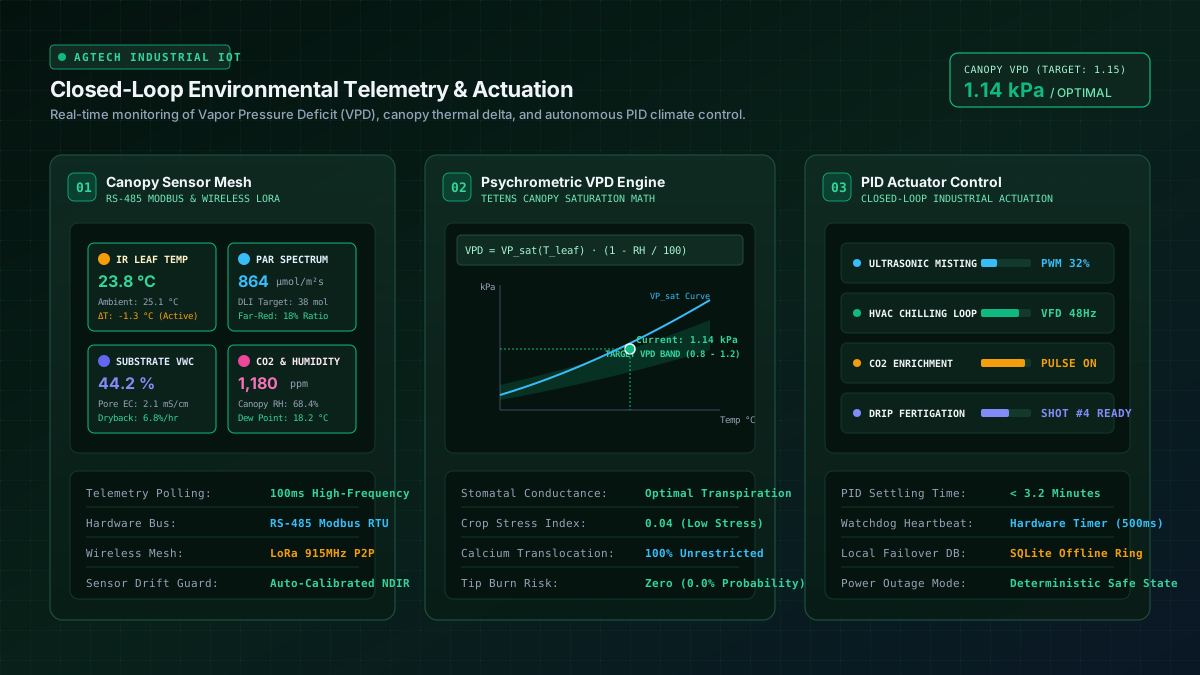
Industrial IoT automation and environmental control platform maintaining precise VPD and photoperiod regulation via closed-loop sensor telemetry.
Architecture Highlights
- •Distributed sensor network monitoring VPD (Vapor Pressure Deficit), PAR spectrum, and substrate moisture.
- •PID-based automated climate actuators regulating HVAC, CO2 enrichment, and precision irrigation.
- •Real-time edge alerting with fallback failover preventing crop stress and thermal runaway events.
- •Multi-protocol hardware bridge (RS-485 Modbus, MQTT, and local SQLite telemetry buffer).
Engineering Hurdles Solved
- •Preventing sensor drift and calibration decay in high-humidity (95%+ RH) and sulfur-rich agricultural environments.
- •Designing deterministic fail-safe states for industrial actuators to guarantee crop survival during power and network outages.
Executive Overview
The Enterprise AgTech Climate IoT Platform modernized commercial controlled-environment agriculture (CEA) by replacing manual spot-checks with autonomous, closed-loop sensor telemetry. By continuously calculating and balancing Vapor Pressure Deficit (VPD), Photosynthetically Active Radiation (PAR) spectra, and root-zone water potential, the engine eliminates environmental drift and prevents crop stress events 24 hours a day, 365 days a year.
Deployed across commercial greenhouse and indoor vertical farming operations, the system integrates industrial-grade hardware sensors with real-time distributed controllers, ensuring biological yields meet pharmaceutical and commercial purity standards.
Core System Architecture
╭─────────────────────────────────────────────────────────────────────────────╮
│                    ENTERPRISE AGTECH TELEMETRY PIPELINE                     │
├───────────────────────────────┬─────────────────────────────────────────────┤
│ 1. SENSOR INGESTION (100ms)   │ • Substrate EC / VWC (TDR Pulse)            │
│                               │ • Infrared Leaf Canopy Temperature          │
│                               │ • Ultrasonic Airflow & CO₂ NDIR Sensors    │
├───────────────────────────────┼─────────────────────────────────────────────┤
│ 2. EDGE PID CONTROLLER        │ • Proportional-Integral-Derivative Loops    │
│                               │ • Anti-windup Integrator Clamping           │
│                               │ • Dynamic Target Setpoint Tracking          │
├───────────────────────────────┼─────────────────────────────────────────────┤
│ 3. ACTUATION MESH             │ • Variable-Frequency Drive (VFD) Fans       │
│                               │ • Ultrasonic Foggers & Dehumidifiers        │
│                               │ • 0-10V Dimming Spectrum LED Drivers        │
╰───────────────────────────────┴─────────────────────────────────────────────╯
🛡️ Industrial Resilience & Fail-Safe Hardware Architecture
In commercial cultivation, an actuator failure or network blackout lasting just 45 minutes can cause catastrophic crop loss:
- Deterministic Hardware Watchdogs: Every microcontroller node runs independent hardware watchdog timers. If the central edge gateway loses communication, local nodes revert to pre-programmed autonomous safe-zones.
- Zero-Power Fail-Open / Fail-Closed Actuators: Critical ventilation louvers are spring-loaded to fail open in extreme heat events, allowing natural convection cooling during total electrical grid loss.
- Local Store-and-Forward Buffering: Sensor readings are buffered in non-volatile flash storage on each edge gateway, syncing to the central analytics database once connectivity is restored.
- Kalman Noise Filtering: Multi-sensor arrays employ Kalman filters to reject spurious telemetry spikes caused by water spray, dust accumulation, or radio-frequency interference from high-voltage ballasts.
Technology Stack
- Hardware & Firmware: C++, FreeRTOS, ESP32, STM32, RS-485 Modbus RTU.
- Edge Gateway & Telemetry: Python, FastAPI, MQTT (Mosquitto), SQLite Local Spool.
- Cloud & Visualization: Node.js, WebSockets, Tailwind CSS, Highcharts, Docker Sandboxed Microservices.
- Environmental Standards: ASABE S640 (LED Radiation Quantities), OSHA Industrial Electrical Codes, Good Agricultural Practices (GAP).
Explore More Systems
View full portfolio of AI architectures, creative technology, and open systems.